My Instagram algorithm, as you can probably guess from what ffeedd covers, is filled with food and fashion: branded dinners, extravagant tablescapes and slow-motion cheese pulls. There’s so much of it that sometimes they all start looking the same. But mid-scroll, a vintage-style Rosemary’s Baby poster stops me, with a mille-feuille riding in the pram and the Wildair name across the bottom.
Wildair opened in 2015 on Orchard Street on the Lower East Side, a few doors down from its sibling restaurant, Contra. Both belong to Jeremiah Stone and Fabián von Hauske Valtierra, who met at the French Culinary Institute and now cook, own and run the two together. Orchard Street made Time Out’s list of the world’s coolest streets last year. Wildair’s creative direction makes it (I might be biased) the coolest restaurant on the block.
I emailed Fabián to learn more.
How Wildair’s creative direction started during Covid
When Covid took over the world, hospitality was one of the hardest-hit industries. With dining in on hold, Wildair became a casual spot selling sandwiches, salads and donuts that went viral. Fabián started thinking about how to show the restaurant to people who had never been inside. For him, Wildair had always been the experience of walking in, seeing the space, smelling and tasting the food, feeling the atmosphere and hearing the music he handpicks. None of that was possible during Covid. “The challenge was showing visually something interesting and hopefully different,” he says.


Wildair’s chefs design their own graphics
“We come up with the dishes, the menu, all the social media and the graphics,” says Fabián, when I ask how involved the kitchen is in Wildair’s visual process. The graphics are so sharp that I’d assumed they came from a professional graphic designer.
Fabián started early. At 15 he was making flyers and merch for his band, building collages on a scanner before he ever learned Photoshop. He says both chefs are into music, typography and anything visual. His references run from the covers of old geometry, physics and math books to graphs and the colors and patterns he grew up with in Mexico. When I ask which fashion designers or artists he looks to, he names band merch, along with Aries Arise, the London label known for its graphic-heavy clothes. He also names Self Edge, the denim store on the same block of Orchard Street as Wildair. He describes the result as “something very clean and plain” with a little chaos added in.


I’ve always heard that creative people do their best thinking in the middle of the night. So when Fabián’s second email landed in my inbox at 1:35am, it made me chuckle and wonder whether he’s closer to an artist than a chef. (I believe all chefs are artists too, but you know what I mean.) Reading it, I could picture how his brain works and how ideas flow when he’s thinking about things he cares deeply about, like his restaurant and art.
How McDonald’s shaped Wildair’s color palette
In that second email, he went deeper into where his ideas come from and how the design process works. He started with McDonald’s, one of the biggest influences on Wildair’s creative direction. He’d always thought the chain was good with visuals, and an old article he read about its branding and color psychology is part of what shaped Wildair’s color palette today. He wanted anyone scrolling past a Wildair post to know it was Wildair.
The restaurant is the restaurant
Fabián has a clear idea of how a restaurant should show itself. Restaurants now build much of their content as stories and series about the food or the chef. He’d rather let the restaurant speak for itself. “We’ve always thought the restaurant is the restaurant,” he says. He wants Wildair to be known through what you experience there. The graphics carry that experience to people who are discovering the restaurant through their phone screens.


Like most restaurants today, Wildair puts real care into photographing its food, and the food looks great. What sets it apart for me is the way Fabián presents it, which gives the restaurant life and personality.
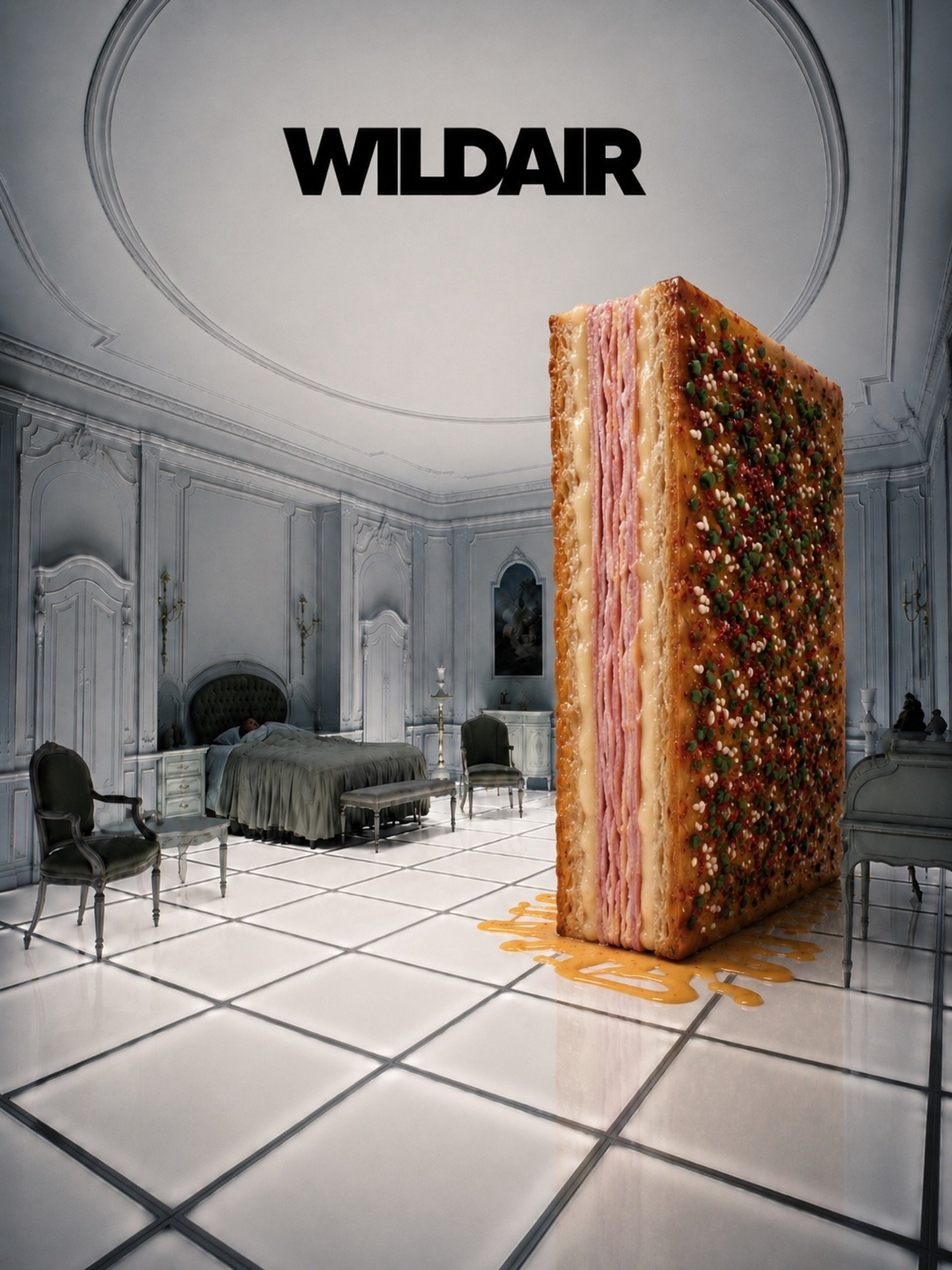
Some of his posters rework vintage film posters around a dish, like the giant ham-and-cheese sandwich that takes the place of the monolith in 2001: A Space Odyssey, or the mille-feuille that stands in for the timpano in Big Night. Others are geometric, closer to the math and physics book covers he mentioned, with lines like “Food is food, wine is wine, Wildair is forever.” And some repeat a single dish across the frame until it becomes a pattern, which is how he says ideas often come to him: “sometimes you start with a shape and then end up with a pattern and it’s like building its own little world.”
A world that keeps changing shape
Wildair’s creative direction is built on a strong foundation that leaves plenty of space to play. Fabián says the bones are already there, so the themes can change every couple of months with whatever is inspiring him. Asked what’s been the most fun part of building it, he said:
“Just treating it like its own world and not just a restaurant.”